Keep Talking I'm Diagnosing You Funny Design Review
As a designer who has spent years navigating the intersection of digital graphics and physical textile production, I approach every new asset with a critical eye. When I first encountered the Keep Talking I m Diagnosing You Funny design, my immediate reaction was one of amusement mixed with professional curiosity. In the world of Crafts, humor is a powerful driver for sales, but translating a witty phrase into a high-quality embroidery project requires more than just a funny slogan. It demands a deep understanding of how text interacts with fabric texture, thread density, and the limitations of our machines.
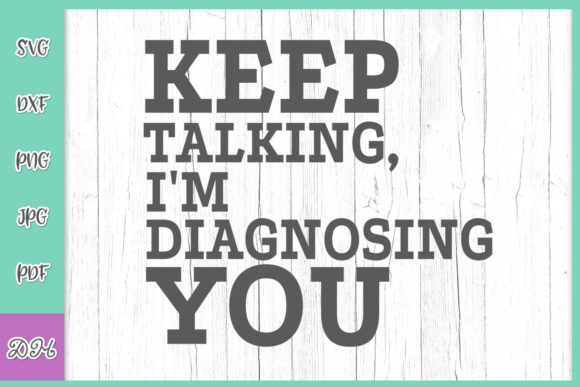
This specific design falls squarely into the Graphics category, offering a vector-based approach that promises versatility. The description notes it comes as an SVG for Cricut and other cutting machines, alongside Png, Dxf, Jpg, and Pdf files. While this variety is excellent for vinyl applications, my focus today is on its potential as a machine embroidery design. Before committing to a commercial run or a client order, I need to know if the visual personality of "Keep Talking I m Diagnosing You Funny" translates well from screen to stitch.
The Visual Personality and First Impressions
The mood created by Keep Talking I m Diagnosing You Funny is instantly recognizable: it is bold, slightly rebellious, and perfect for the modern medical professional or the self-proclaimed armchair doctor. The layout appears clean, which is crucial when dealing with text-heavy designs. In embroidery, complex curves and tiny serifs can get lost in the needlework, turning crisp lettering into a muddy blob. This design seems to prioritize readability, which is a strong foundation for any custom apparel piece.
When I visualize this as a tote bag design, the impact is significant. Imagine a sturdy canvas tote, perhaps in a neutral beige or crisp white, featuring this phrase in a contrasting navy blue or bright red. The simplicity of the message allows the stitching to do the heavy lifting without overwhelming the viewer. However, the real test lies in the execution. Does the font weight hold up under a fill stitch? Will the spacing between letters remain consistent when the fabric stretches? These are the questions that separate a hobbyist project from a professional finished product.
Real-World Application: From Hoop to Shelf
Let's consider a practical scenario. A local boutique owner wants to create a line of sweatshirt embroidery items for the upcoming holiday season. They are targeting nurses, doctors, and therapists who appreciate a touch of dark humor. If we were to use Keep Talking I m Diagnosing You Funny here, the placement becomes critical. On a sweatshirt, the chest area offers ample room, but the curved surface of the torso can distort straight text if not stabilized correctly.
In this context, the design serves as a conversation starter. Customers don't just buy a shirt; they buy an identity. The handmade product value increases significantly when the embroidery looks professional. If the stitch density is too low, the fabric might show through, making the design look cheap. Conversely, if it is too dense, the garment could become stiff and uncomfortable against the skin. As an experienced reviewer, I would recommend testing this design on a scrap piece of fleece first to ensure the thread colors pop without creating puckering.
Another viable application is the embroidered patch. Patches allow for higher stitch counts and denser fills because the backing stabilizer is often heavier. A patch featuring this saying could be sewn onto denim jackets, backpacks, or even caps. The durability of a patch makes it ideal for items that undergo frequent washing, ensuring the commercial embroidery maintains its integrity over time. For an Etsy seller, offering this design as both a direct embroidery service and a patch option diversifies the inventory while utilizing the same core asset.
Navigating Fabric Challenges and Technical Limits
While the design is promising, there are specific situations where caution is required. Text-based designs like Keep Talking I m Diagnosing You Funny can struggle on textured fabrics such as linen or heavy waffle weave. The uneven surface can cause the needle to skip or the thread to sink, obscuring the fine details of the lettering. Similarly, stretchy fabrics like jersey knit require a specialized stabilizer to prevent the text from warping once the garment is worn.
Dark fabrics present another challenge. To make light-colored thread stand out against black or navy material, you may need a top layer of cutaway stabilizer or even a layer of underlay stitches. Without these precautions, the design assets might appear dull or lack definition. Additionally, if you plan to use this on a cap, the curved brim and the small hoop size can compress the text, potentially making the smaller words harder to read. Always check your machine's capabilities regarding hoop size before attempting intricate text on curved surfaces.
Practical Designer Notes for Success
To truly leverage Keep Talking I m Diagnosing You Funny in your craft business, follow these practical steps:
- Test on Scrap Fabric: Never skip the test run. Stitch the design on a fabric similar to your final product to check for puckering and alignment.
- Verify File Formats: Since the product listing includes Svg, Png, Dxf, Jpg, and Pdf, ensure you have the correct software to convert these into an actual embroidery file format (like PES, DST, or XXX) compatible with your machine. The provided files are primarily for cutting or printing, not direct stitching.
- Check Thread Contrast: Use a color wheel to select thread colors that offer maximum contrast against your chosen background. High contrast ensures the message is legible from a distance.
- Review Licensing: Before selling personalized gifts or small shop products featuring this design, confirm the licensing terms. Ensure you are permitted to sell finished goods made with this graphic.
- Mockup Your Ideas: Create a printable mockup to visualize how the design looks on different items like aprons, pillow covers, or baby clothes. This helps in marketing and setting customer expectations.
The Keep Talking I m Diagnosing You Funny design has the potential to be a best-seller if executed with care. Its strength lies in its relatability and clear messaging. However, the success of the final embroidery project depends entirely on the technical execution. By paying attention to stitch density, choosing the right stabilizer, and respecting the limitations of your equipment, you can transform a simple graphic into a high-value handmade product.
Whether you are creating a holiday gift for a friend or stocking shelves for your online store, remember that quality builds trust. A well-stitched, readable, and durable design enhances your brand consistency and encourages repeat customers. In the competitive world of Crafts and Graphics, the difference between a good product and a great one often comes down to these meticulous details. Take the time to prepare, test, and refine, and Keep Talking I m Diagnosing You Funny will undoubtedly become a standout piece in your collection.